Jerry was a man of integrity and a quiet leader. He faithfully studied God’s Word and was a prayer warrior. Jerry was a powerful example to me. Perhaps you remember someone like this in your life. What specific qualities did you admire in them?
In the Old Testament, the book of Nehemiah presents an extraordinary man. We know he was not perfect (see Nehemiah 1:6), yet he was a devoted worshiper of the One True God. He recognized the Lord as the great and awesome God (Nehemiah 1:5; Psalm 70:4). He trusted in God’s truthfulness and relied on His covenant-keeping love for those who walk in His ways. This man humbled himself before the Almighty God of heaven!
Nehemiah faithfully served the king in a foreign land. He adhered to the royal court’s regulations and remained loyal to the regime. He was trusted to hold the king’s confidence in private conversations, political discussions, and government decisions.
In the late autumn, Nehemiah received troubling news from his brother. I shared this in an earlier blog post. He sat down and wept, and for days he mourned for the people of Jerusalem. He fasted and prayed to the God of heaven.
A few months passed, and in early spring Nehemiah was serving King Artaxerxes his wine. It was not acceptable to show sadness in the king’s presence. However, the king recognized that his faithful cupbearer was deeply troubled and asked, “Why are you looking so sad?”
Then I was terrified, but I replied, “Long live the king! How can I not be sad? For the city where my ancestors are buried is in ruins, and the gates have been destroyed by fire.”
The king asked, “Well, how can I help you?”
- Nehemiah 2:2-4a
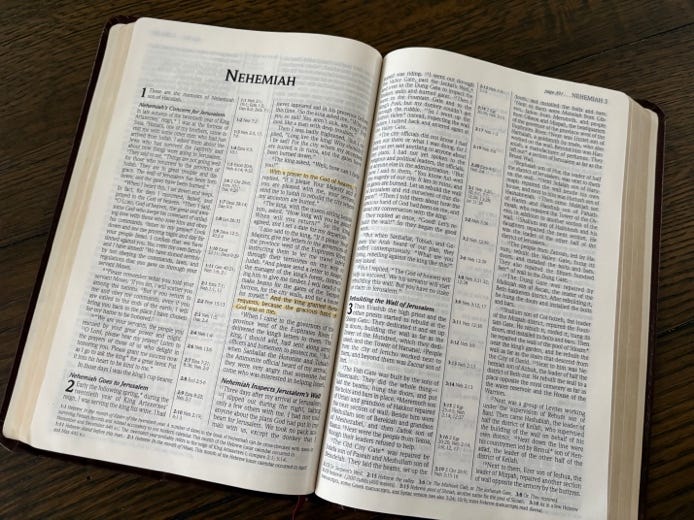
With a prayer to the God of heaven, I replied, “If it please the king, and if you are pleased with me, your servant, send me to Judah to rebuild the city where my ancestors are buried.”
- Nehemiah 2:4b-5
Nehemiah had prayed for weeks and months. He had asked the Lord to restore the gates and walls of Jerusalem. Now the king asked him, “How can I help?” The Lord opened a door for Nehemiah to speak, but he knew he must speak respectfully. Nehemiah prayed silently to the God of heaven before he spoke.
The king, with the queen sitting beside him, asked, “How long will you be gone? When will you return?” After I told him how long I would be gone, the king agreed to my request.
- Nehemiah 1:6
Nehemiah was a gifted administrator. In his conversation with the king, he outlined key elements of his plan. He recognized that his envoy would need the king’s permission to travel safely from Susa to Judah. Nehemiah requested a letter to Asaph, asking for timber from the king’s forest. Nehemiah had spent many hours in prayer, and God had guided his thoughts toward restoring the gates and city walls.
I also said to the king, “If it please the king, let me have letters addressed to the governors of the province west of the Euphrates River, instructing them to let me travel safely through their territories on my way to Judah. And please give me a letter addressed to Asaph, the manager of the king’s forest, instructing him to give me timber. I will need it to make beams for the gates of the Temple fortress, for the city walls, and for a house for myself.”
- Nehemiah 1:7-8a
Nehemiah recognized the importance of the work and believed God was calling him to lead his people in completing this major reconstruction project. I can only imagine the thoughts, plans, and ideas racing through his mind. He would need to seek the Lord’s guidance and apply sound strategy and wise management skills.
And the king granted these requests, because the gracious hand of God was on me.
- Nehemiah 1:8b
Even as the king granted Nehemiah permission to travel to Jerusalem to oversee the rebuilding of the city’s gates and walls, Nehemiah offered praise to God. Nehemiah believed the Lord had called him to this work and credited God with the king’s favorable response to his requests.
Head to Heart
Do you recall a specific time when you felt God’s gracious hand upon you? Take a moment to reflect on the details of that experience. How did He provide for and care for you? What was your response to the Lord?
Prayer can feel difficult at times because of fatigue, distractions, guilt, or a sense of distance from God. Yet prayer is about presence rather than performance. You can speak simply, honestly, and briefly, for example, by saying “Help me.” When words fail, it helps to pray verses from Scripture (such as the Psalms) or the Lord’s Prayer.
Keep it Simple: Prayer is simply talking to God. If you can only say, “Father, I’m here,” that is enough.
Pray Scripture: Use the Psalms to express your feelings when you cannot find your own words.
Rely on the Holy Spirit: Remember that the Spirit intercedes for you, especially when you feel you can’t pray.
Lean on Community: Ask a trusted friend or mentor to pray for you or with you.
Focus on God’s Character: Remind yourself of God’s love and care rather than dwelling on fear, guilt, shame, discouragement, or inadequacy.


Discover God’s Truth is now on YouTube

Watch, share, and subscribe at youtube.com/@discovergodstruth.